
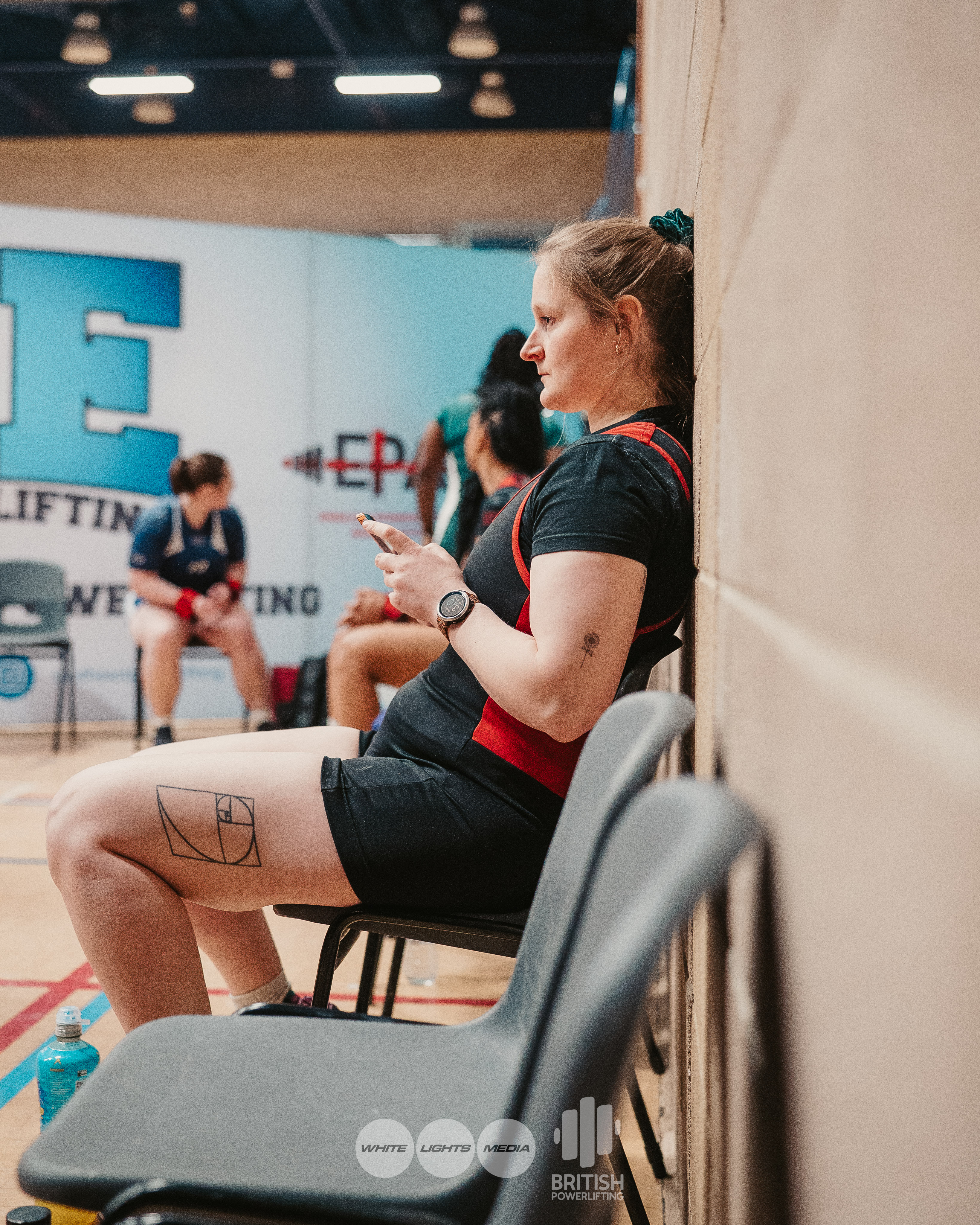
Every lifter feels it to some degree: the walk out to the platform, the chalk, the wait for the head referee’s command, and somewhere in that sequence a climbing heart rate and cold hands. New lifters tend to assume that this means something has gone wrong, when for the most part it hasn’t.
I’ve spent a fair amount of time on the other side of the platform, judging lifters at every level from first-timers through to international competitors, and what consistently stands out is that the lifters who perform well on the day are not the ones who arrive without nerves. They tend to be the ones who understand what those nerves actually are, and who have given some thought in advance to how they intend to manage them. That is what I want to work through here.
Nerves aren’t the problem
Your body’s response to a heavy single in training and a heavy single on the platform is, in physiological terms, fairly similar: adrenaline, a raised heart rate, narrowed focus, a degree of tunnel vision. None of that is a malfunction, and it is worth being clear on that point, because it is your body preparing to do something difficult, which is precisely what you want it doing in the moments before a maximal attempt.
The relationship between arousal and performance is usually described as an inverted U, and while that is something of a simplification, it remains a useful way to picture what is going on. Too little arousal and you tend to be flat, slow off the floor and loose through your setup; too much, and coordination and decision-making start to suffer. The goal, then, was never to remove the nerves altogether, but rather to land somewhere in the usable middle of that curve.
There is also a reasonably well-established body of research on what is often called arousal reappraisal, and the underlying idea is worth knowing. The same racing heart can be interpreted as “I am anxious and this is going badly”, or as “this is my body getting ready to do what I have trained it to do”. The physiology itself is more or less identical; what differs is the interpretation, and it is the interpretation that feeds through into how you actually perform. The implication is that you do not need to talk yourself out of feeling activated, but instead to recognise that feeling for what it most likely is, which is readiness.
The week before
By the final week, the training itself is essentially done. The work has been banked, and nothing you do in those last few days is realistically going to add fitness, although a number of things can quietly subtract from it. It is worth resisting the urge to test, to add in an extra session, or to otherwise “make sure”, because confidence at this stage does not tend to come from one more heavy day. It comes, instead, from trusting the months of training that sit behind you, which is harder to do, but is also the thing that actually holds up under pressure on the day.
What is worth your attention in that final week is logistics, largely because uncertainty is what nerves feed on. Knowing your opening attempts, knowing when weigh-in is and what the timeline looks like afterwards, and packing your bag the night before rather than on the morning itself all serve the same purpose: the more of meet day that has already been decided in advance, the less there is left to turn over in your mind while you wait. Sleep is perhaps the single variable most worth protecting across that last stretch, and it is also, unfortunately, one of the most likely to slip in the nights before you compete.
Knowing the rules: uncertainty is what rattles you
The pattern I see most consistently from the referee’s chair is that the kind of panic that genuinely costs lifters attempts is rarely about strength at all. It is far more often about not knowing what is coming next.
Lifters lose attempts to things that have very little to do with how much they can lift: moving before the command has been given, racking early, not waiting for the signal at the bottom of a bench press. Each of those is avoidable, and each becomes considerably more likely when a lifter is already rattled and not entirely sure of the procedure in the first place.
The solution is fairly straightforward, even if it is not always comfortable. Learn the commands for each lift, and then actually practise with them in the final few weeks of training, ideally with someone calling your squat, bench and deadlift exactly the way a referee would on the day. When you have heard those commands a hundred times before you ever step onto the platform, the platform itself stops being an unfamiliar environment; you already know what the referee is going to say, and your only real job is to lift. In my experience that familiarity is one of the more reliable ways to take the edge off, and it costs nothing more than a little attention during training you were doing anyway.
Meet day: managing the gaps
A meet is, structurally, a series of long waits broken up by a small number of very short efforts. Most lifters prepare quite carefully for the efforts and barely at all for the waiting, and yet the waiting is usually where the nerves do most of their damage.
It is worth having some kind of plan for that downtime. What you are trying to avoid is spending two hours sitting inside your own head, rehearsing every attempt repeatedly before it happens; eating something, moving around a little and talking to the people around you all tend to be more useful than the alternative, and the focus can reasonably be saved for the point at which it actually counts. It also helps to have a simple routine for the ten minutes or so before you are called, ideally the same sequence each time. Whatever it consists of, it should be repeatable and it should be yours. The routine is not superstition; it functions as a way of signalling to your nervous system that it is time to work, without you having to arrive at that decision fresh, under pressure, on every single attempt.
Focus on what you control
There is a fairly clear line between the things you can control on the day and the things you cannot. You cannot control the other lifters in your category, you cannot control which way the red and white lights happen to fall, and you cannot control where your total eventually places you once the day is done.
What you can control is your warm-up timing, your opener selection, your setup, and your execution of the commands, and for the most part that is the entire list. Lifters who find themselves fixating on the things outside that list tend to carry every missed attempt and every unexpected result forward into the next lift with them, whereas lifters who manage to keep their attention inside it are generally able to treat each attempt as its own separate task, which is, in fact, exactly what it is. Narrowing your focus down to the next attempt, and only the next attempt rather than the several that follow it, is one of the more practical skills you can develop, and like most things discussed here, it is worth rehearsing in training well before you are required to rely on it on the platform.
The shift that matters
It is worth remembering, finally, that the nerves are there in the first place because the result matters to you, and that is not in itself a small thing, nor is it really a problem to be solved. The aim was never to become a lifter who does not care, or who feels nothing at all walking out to compete; that lifter would not perform any better for it, and would in all likelihood perform somewhat worse.
The aim is something rather narrower, and a good deal more achievable, than “calm”. It is, more or less, to bring the same lifter who shows up reliably in training onto the platform with you, with the same setup, the same execution, and the same trust in work that has already been done. The nerves can come along; they simply do not need to be the thing in charge. Much of what is described above is really just the practical detail of how you get to that point.
If you are working towards your first meet, or trying to put together a stronger one than last time, that is precisely the sort of thing coaching is useful for. Do get in touch, and we can talk through what that might look like.